
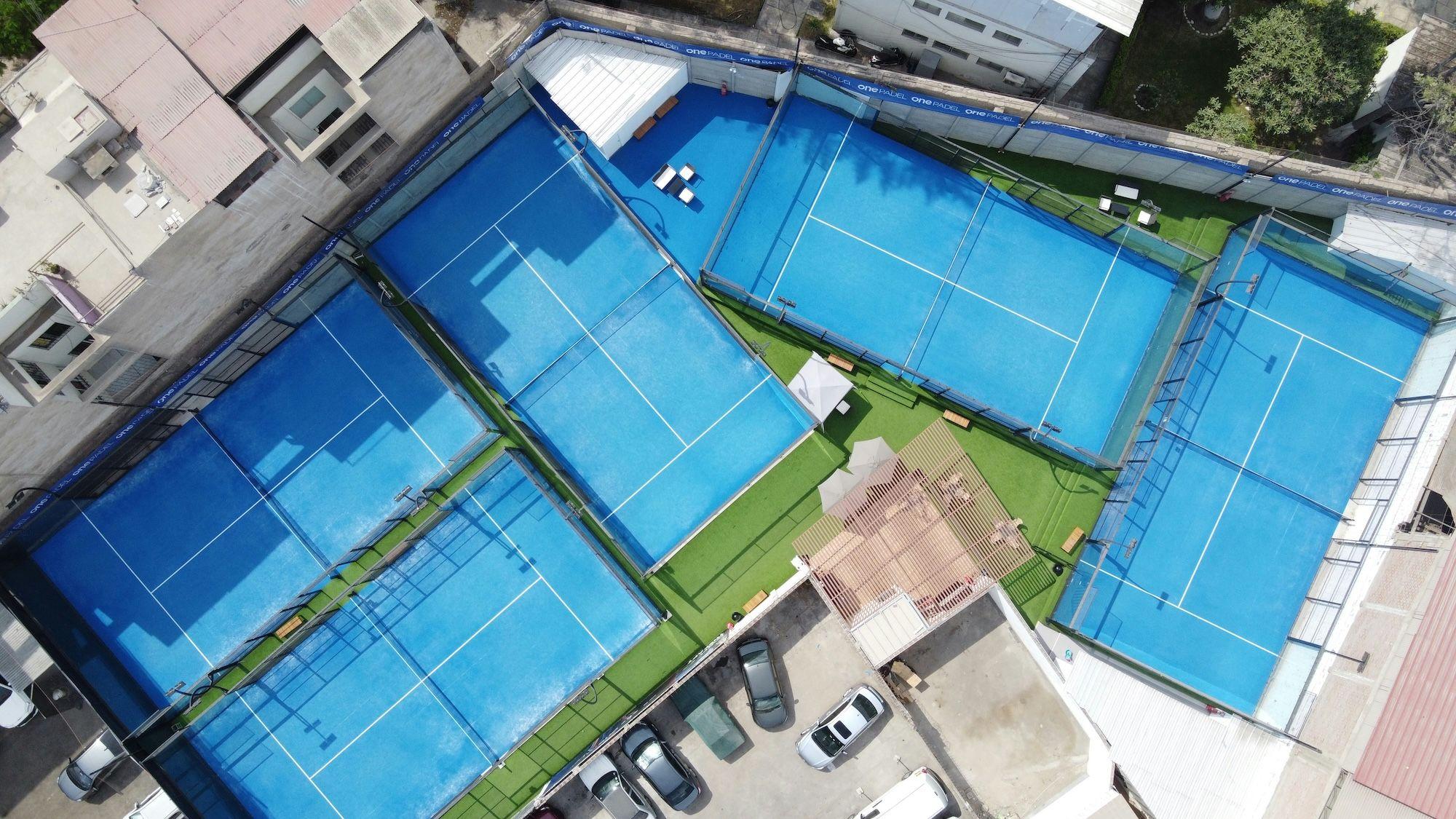
Padel court dimensions explained: size, lines, walls and net height
A regulation doubles padel court is 10 meters wide and 20 meters long on the inside - about 32.8 by 65.6 feet. That gives players 200 square meters of playing surface, enclosed by walls and fencing. But the dimensions only tell half the story: the service lines, net, enclosure and overhead clearance make this court different from any tennis or pickleball court.
Here is a practical guide to the measurements, using the International Padel Federation (FIP) rules effective January 1, 2026.
Padel court measurements at a glance
| Feature | Official measurement | Approximate US equivalent |
|---|---|---|
| Inside court length | 20 m | 65 ft 7 in |
| Inside court width | 10 m | 32 ft 10 in |
| Playing area | 200 sq m | 2,153 sq ft |
| Service line from net | 6.95 m on each side | 22 ft 10 in |
| Net height at center | 0.88 m | 2 ft 11 in |
| Net height at ends | 0.92 m | 3 ft |
| Minimum unobstructed height | 6 m | 19 ft 8 in |
| Suggested clearance for new facilities | 8 m | 26 ft 3 in |
These are playing-court dimensions, not the size of the entire building or land parcel. Access, structures, circulation and any out-of-court safety space can increase the overall footprint.
How the lines divide the court
Imagine the 20-meter length split into two equal halves by the net. Each team defends one 10-by-10-meter half. A service line runs across each half 6.95 meters from the net, leaving the deeper area between the service line and the back wall.
A central service line divides each service area into a left and right box. The center line extends at least 20 centimeters beyond the service line. Court lines are 5 centimeters wide.
That layout matters because a legal serve goes diagonally into the opposite service box. Once the serve has been returned, the players use the entire court and, in many situations, the enclosing walls. For the precise mechanics, see our step-by-step padel serving guide.
How high is a padel net?
The net runs across the court's 10-meter width. Its top is 0.88 meters at the center and 0.92 meters at the ends - slightly lower in the middle.
This sounds like a small distinction until you start playing. A ball crossing near the middle has a little more clearance, but trying to thread every shot an inch above the net is still a high-risk habit. Beginners generally benefit more from a reliable margin and good placement than from spectacularly low shots.
What are the glass and mesh walls for?
A padel court is fully enclosed. At the back ends, the standard enclosure reaches 4 meters high, commonly with 3 meters of solid wall or glass and a top meter of mesh. The side enclosures can use different FIP-compliant configurations, combining rebound walls with metal fencing.
The most important playing distinction is that glass or solid walls can return a ball into play after the proper bounce. The ball behaves differently when it meets mesh, so players learn to read the rebound rather than treating every part of the enclosure alike.
You do not have to master every wall angle on day one. Start by allowing a deep ball to bounce, waiting for its rebound from the back glass, and then returning it with a controlled swing. Our beginner's introduction to padel explains how the wall changes rallies.
Does every padel court need the same space around it?
No - and this is where a simple "10 by 20 meters" answer can mislead venue planners.
- Indoor clearance: FIP specifies at least 6 meters of unobstructed height throughout the court and suggests 8 meters for new facilities.
- Court access: Entry openings are built into the side enclosure, with permitted layouts and dimensions described in the rulebook.
- Out-of-court play: When this style of play is authorized, special access and clear safety areas outside the court are required. FIP's 2026 rules call for at least 3 meters of width and 4 meters of length on each side, plus overhead clearance.
- Other site needs: Walkways, seating, emergency access, lighting, structural foundations and local building requirements may increase the practical site size.
If you are considering building a court, use the FIP dimensions as a sporting baseline, not as a substitute for a site-specific construction plan or local approvals.
Padel court vs tennis court: why size alone is misleading
A regulation tennis doubles court is longer and slightly wider than a padel court. But the bigger difference is how each sport uses its boundaries.
- Tennis generally needs space outside the lines so players can chase long and wide balls.
- Padel deliberately puts playable rebound walls around its smaller surface.
- Padel rallies reward reading glass rebounds and sharing a compact court with your partner rather than running far behind a baseline.
A padel court cannot be created simply by painting new lines on a tennis court. The enclosure, surface, access and net are essential parts of the sport. For naming and rule differences, see padel vs paddle tennis.
Common questions about padel court sizes
Is a padel court 20 by 10 meters? Yes. The same measurements are sometimes written as 10 by 20 meters - width first, then length.
Are singles courts the same size? The standard FIP court described here is for doubles. Narrower recreational singles variations exist, but they should not be confused with regulation doubles measurements.
Is all the wall made of glass? No. Glass is common because it lets spectators see in, but regulations also allow other suitable wall materials and require areas of metal mesh.
Can a padel court fit inside a warehouse? Potentially, if the building has enough width, length, clear height, compliant access and suitable structural conditions. A plan based only on the 200-square-meter playing area is not sufficient.
Find a regulation-size court near you
If you want to experience the dimensions rather than picture them, explore the WhatThePadel US court directory. Browse by state and city, then check each venue's court type, opening information and booking instructions. If securing a slot proves difficult, our guide to finding available padel court bookings can help.
Technical reference: FIP Rules of Padel - review applicable from January 1, 2026. Court measurements and facility requirements should always be checked against the current governing document and relevant local rules.