
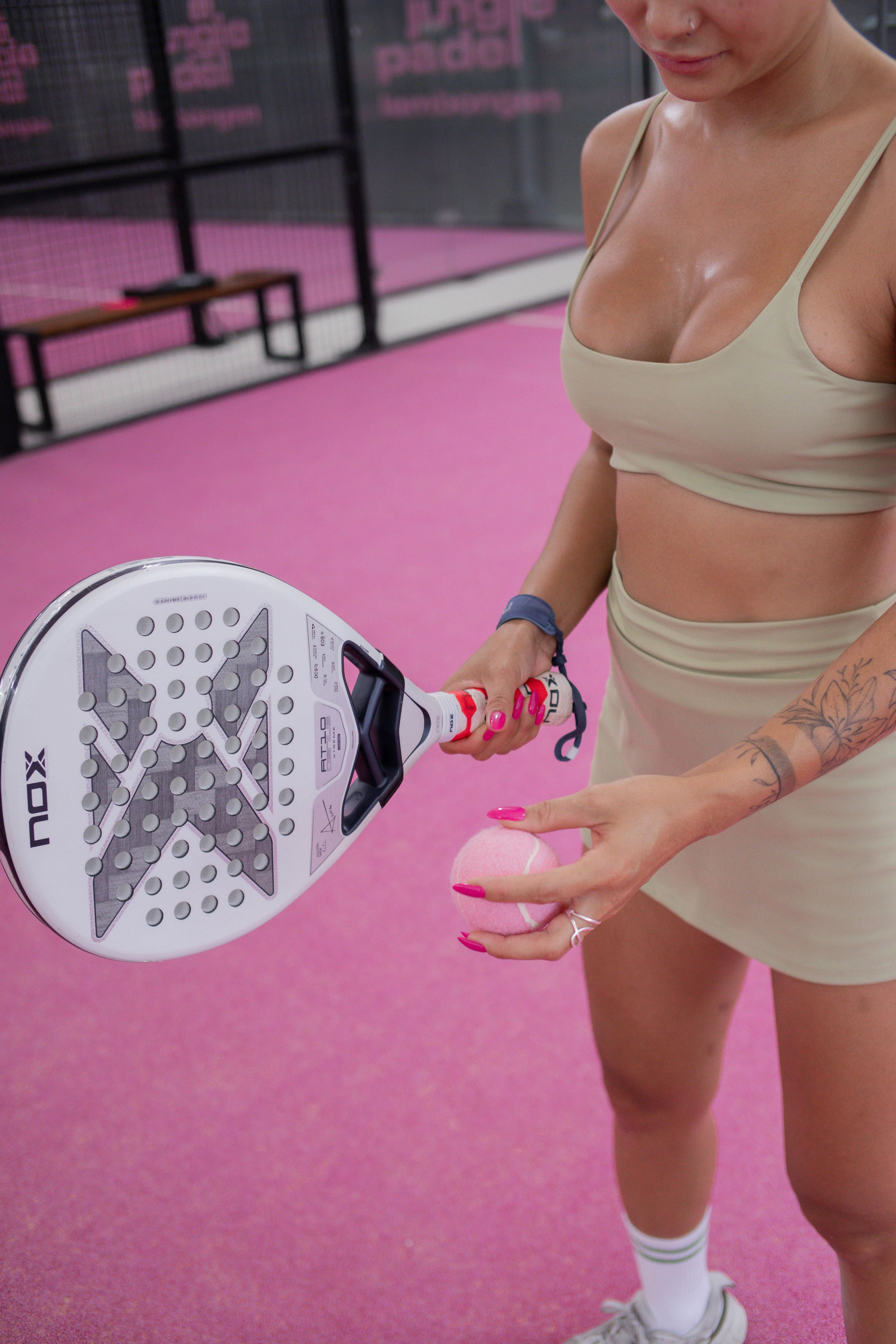
What is padel? A complete beginner's guide to the sport
Padel is a doubles racket sport played on an enclosed court smaller than a tennis court, where the glass walls are part of the game. You serve underarm, rally using the walls like a squash player, and score much as you would in tennis. It is the fastest-growing racket sport in the world, and one of the easiest to pick up.
If you have seen a glass box full of people having an unreasonably good time and wondered what you were looking at, this is it.
Padel at a glance
| Players | Doubles only - two against two |
| Court | 10m x 20m, enclosed by glass and mesh |
| Racket | Solid and perforated, no strings |
| Ball | Like a tennis ball, slightly lower pressure |
| Serve | Underarm, must bounce first |
| Scoring | 15, 30, 40, game - as in tennis |
| Match length | Usually 60-90 minutes |
| Invented | Acapulco, Mexico, 1969 |
The court is the whole point
A padel court is 10 metres wide and 20 metres long, enclosed on all sides by glass walls and metal mesh. That enclosure is not a fence to stop the ball escaping - it is playing surface.
The playing area is somewhat smaller than a tennis court, which measures 10.97m by 23.77m for doubles. The bigger saving is in run-off space: because the walls contain the ball, a padel court needs far less clearance around it, which is why they fit into sites where a tennis court never would.
When your opponent hits the ball past you, it rebounds off the back glass and comes back into play. You can let it bounce on the ground, then off the wall, and hit it from there. You can even play the ball into your own glass to send it back over the net. Rallies that would have ended in tennis simply keep going.
This is the single biggest reason padel is fun within about twenty minutes of picking up a racket. In tennis, a beginner's rally ends when someone hits it too hard. In padel, the wall gives it back.
How a point works
The server bounces the ball and strikes it at or below waist height into the diagonal service box. Underarm, always - there is no big first serve to master, which removes the single hardest barrier to entry in tennis. At least one foot must be in contact with or behind the service line at impact.
From there the ball is live until it bounces twice, and both walls and glass are fair game. Volleys are allowed at any point except on the return of serve.
Scoring runs 15, 30, 40, game, with sets played to six games. The one place padel diverges from tennis is at 40–40, where three formats now exist: traditional advantage, the golden point, and the Star Point introduced by the FIP in 2026. See how padel scoring works for the detail, and the official padel rules for beginners for the full rulebook in plain English. The 2026 FIP rule changes cover what moved most recently.
Why padel is easy to start and hard to master
The learning curve is unusually generous at the bottom. The racket is short and solid, so mis-hits still go roughly where you intended. The court is small, so you do not need to cover much ground. The serve is underarm. Most people play a genuine, enjoyable rally in their first session - something that takes months in tennis.
What takes longer is the strategic layer. Good padel is slow, patient and positional: lobbing to push opponents off the net, taking the net yourself, using the glass deliberately rather than desperately. Beginners hit hard. Better players almost never do. That gap is where the sport gets interesting, and it is why playing against better players is the fastest way to improve.
It is also relatively kind to the body. There is no overhead serve motion straining your shoulder and less ground to cover than tennis, which is why so many lapsed tennis players end up here.
Padel is not paddle tennis, platform tennis, or pickleball
This trips up almost every American newcomer, largely because of the names.
- Paddle tennis (now often called POP Tennis) and platform tennis are different, older, mostly American sports. No glass walls, different courts, different equipment, different governing bodies.
- Pickleball is played on a small open court with a perforated plastic ball and a much shorter rally.
- Padel tennis is not really a thing - people say it, but the sport is just called padel. It is pronounced pa-DEL, closer to the Spanish than to "paddle".
The differences run deeper than naming, and we broke them all down in padel vs paddle tennis.
What you need to start
Almost nothing. Most clubs rent rackets, and courts supply balls or sell them cheaply. Wear trainers with decent lateral grip - running shoes work for a first session but will not hold up.
One thing to know: every padel racket must have a wrist cord, and since 2026 letting it break or detach during a point costs you the point outright.
Since padel is doubles-only, you need four people. If you cannot round up three friends, most clubs run open sessions, mixers, or partner-matching for exactly this reason, and it is worth asking rather than assuming you need a full group. Once you are playing regularly, gym work for padel and solo practice drills will move your game faster than more casual matches will.
Where to play padel in the US
There are now more than 1,000 padel courts across the US, spread over 30-plus states, so your odds of finding one nearby are far better than they were a year ago. Some of the biggest markets:
Or browse all padel locations by state and city.
Be warned that booking can be competitive in established markets - here is why it is so hard to book a padel court, and how to work around it.
Common questions
Is padel the same as paddle tennis? No. They are separate sports with different courts, rackets and rules. Padel uses enclosed glass walls that are played off during rallies; paddle tennis does not.
What is padel called in America? Padel. The confusion comes from paddle tennis and platform tennis, which are older American sports with similar-sounding names.
Can you play padel on a tennis court? Not properly. A padel court needs the glass and mesh enclosure, and it is a different size and shape. Some venues convert a tennis court into padel courts, but it is a rebuild rather than a line repaint.
Can you play padel as singles? Padel is designed for doubles and effectively always played that way. A few clubs have narrow dedicated singles courts, but they are rare.
How long does it take to learn? Most people rally in their first session and play a real match within two or three. Competence takes months, like any sport.